
Youth embrace digital tools to protect Uganda's forests
Young forest champions taking data using their phones on the status of the tree cover in Kitubulu Central Forest Reserve. (Credit: Prossy Nandudu)
Youth embrace digital tools to protect Uganda's forests
By Maureen Nakatudde
As Uganda continues to grapple with extreme weather conditions, including prolonged heat, drought and drying water sources, environmental experts warn that human activities such as deforestation and wetland encroachment are worsening the climate crisis.
Trees provide canopy cover that shields the ground from direct heat, while wetlands act as natural water reservoirs, storing water during rainy seasons and releasing it gradually to rivers, lakes and other water sources during dry periods.
Despite these benefits, the growing demand for forest products, coupled with increasing pressure to convert forests and wetlands into recreational facilities and settlements, is threatening many of Uganda's protected ecosystems, particularly central forest reserves located near urban areas.
According to the National Forestry Authority (NFA), forests not only supply timber and fuelwood but also provide critical ecosystem services, including soil conservation, protection of water catchments, riverbanks and lakeshores, biodiversity conservation, climate change mitigation and recreation.
The Ministry of Water and Environment reports that Uganda's environmental degradation is accelerating. Forest cover has declined from 53 percent in 1900 to 24 percent in 1990 and further to 12.4 percent in 2017, representing a loss of about 2.4 million hectares. Meanwhile, wetlands continue to disappear at an estimated rate of two percent annually, with national wetland coverage shrinking from 15.6 percent in 1994 to 13 percent in 2019.
Gad Okedi, a youth forestor explaining to Eva Ntara from FAO how the digital tool can help monitor the health status of a tree or plant in Kitubulu Central Forest Reserve reserve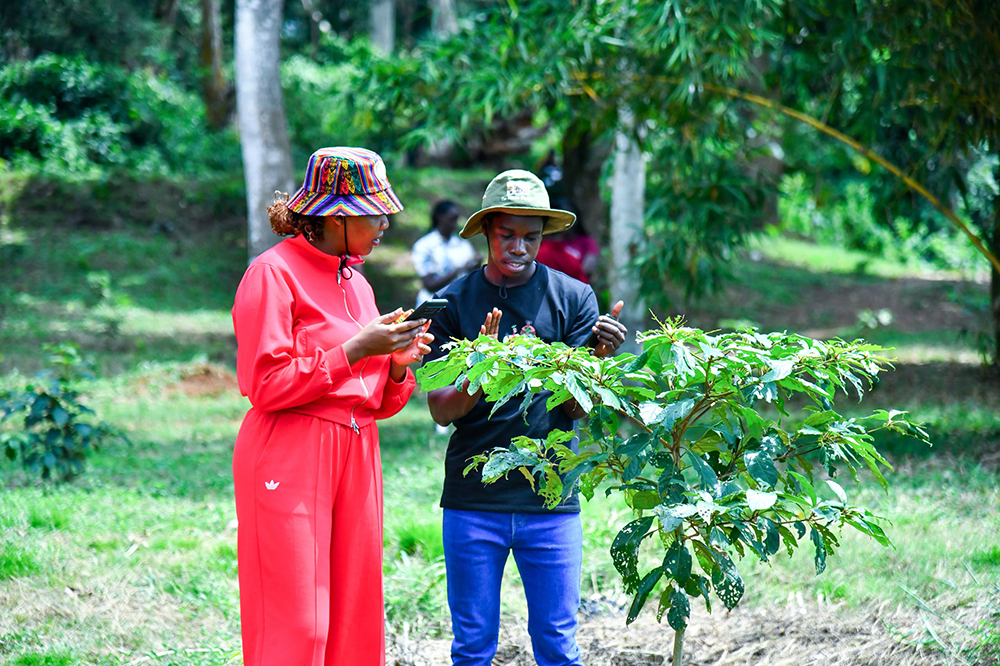
To strengthen community participation in forest conservation, the Food and Agriculture Organisation (FAO), in partnership with the UK Government, is working with the local non-governmental organisation Youth Go Green to equip young people with digital skills to monitor forests and support restoration efforts.
The pilot project is being implemented at Kitubulu Central Forest Reserve in Entebbe, where increasing demand for lakeside land for recreation and settlement has put the forest under pressure. Using digital monitoring tools, young conservationists are tracking forest cover and assessing the extent of deforestation to guide restoration efforts.
Eva Ntara, the FAO's Forest Monitoring and Youth Engagement Specialist, said the initiative seeks to equip young people with practical digital skills that can improve forest conservation.
"We are using the Open Foris Ground tool because it is open-source and accessible to everyone. Many people plant trees but rarely monitor their survival, which is one reason many tree-planting initiatives fail—not only in Uganda but around the world," she said.
Ntara explained that forest monitoring is often expensive and labour-intensive. However, equipping young foresters with digital tools makes the process faster, more efficient and easier to scale.
The programme is currently running in six countries. In Uganda, where it started last year, 30 young people have already been trained to monitor forest cover in central forest reserves using digital technology.
Selecting the youth
Ntara said participants are selected based on the environmental projects they are already implementing within their communities.
"We identified young people who were already making a difference through environmental initiatives and decided to strengthen their capacity. We are also working with the Ministry of Water and Environment and Youth Go Green to reach even more young people across Uganda," she said.
Youth Go Green's role
Edwin Muhumuza, Team Leader at Youth Go Green and lead implementer of the project, said the organisation works with more than two million young people across Uganda to promote environmental restoration.
Under the Young Forest Champions Programme, implemented in partnership with FAO and the Ministry of Water and Environment, participants receive training in forest monitoring, restoration, proposal writing and other environmental skills.
He explained that Kitubulu Central Forest Reserve was selected because it faces increasing encroachment while also serving as an important habitat for several rare bird species.
"Last season, we planted more than 15,000 indigenous trees to restore the degraded forest. The young forest champions are now monitoring which trees survived and which did not. The more young people we train, the greater our capacity to monitor other central forest reserves across the country," he added.
Beneficiaries speak
Dickson Kayongo, a forester and participant in the Young Forest Champions 2026 programme, said the training introduced him to the Open Foris Ground tool, which enables users to collect and interpret forest data.
"The tool allows us to map forest areas, collect field data and generate information that supports informed decision-making," he said.
Kayongo, who founded Next Gen Green Uganda in Lwengo District, hopes to transfer these skills to university students and other young people interested in environmental conservation.
"We also hope to train young people as data collectors and analysts so they can work with government and conservation organisations. This will create employment opportunities while protecting forests," he said.
Bernadette Natukwasa, a trainee with the Ministry of Water and Environment's Forestry Management Department, said the training highlighted the importance of monitoring trees after planting.
"Many tree-planting campaigns end once the seedlings are in the ground. Using this digital tool, we can monitor survival rates and identify areas that need replanting," she said.
Ekel Fiona, founder of Dika Organics Limited and another Young Forest Champion, said the Open Foris Ground tool enables users to collect data even without an internet connection.
"It helps us identify tree species, assess soil conditions and determine whether trees are healthy or dying. That information helps us decide what action should be taken next," she said.
This version reduces repetition by about 30%, improves flow, and follows a more professional newspaper feature style while preserving all the key information.